

 List of Articles

 Search by Area
 Book your trip
 Tour
 Local Experience
 Rental Car
 Hotels
 Golf
 VILLA
 Search articles
 Tour search
Akan International Crane Center | A spot in Kushiro where you can see Japanese cranes all year round.
-

- Post
-

- Last updated: September 11, 2018
 Table of contents
2. Highlights of the Akan International Crane Center
3. Encounter beautiful red-crowned cranes in the outdoor enclosure.
4. Capture breathtaking scenes with your camera at the "Red-crowned Crane Observation Center."
5. Enjoy birdwatching in the biotope.

The Akan International Crane Center is located in Akan-cho, Kushiro City, in eastern Hokkaido.
Akan Town is also a wintering ground for the Japanese crane, a special natural monument.
This area has a long history of protecting red-crowned cranes and is known as the birthplace of artificial feeding of red-crowned cranes.
The Akan International Crane Center was established in 1996.
Specialized researchers are constantly studying and sharing information about the ecology and behavior of the Japanese crane.
This is the only facility in Japan dedicated to the protection of the Japanese crane, and these activities contribute to its conservation.
This time, we'll introduce you to the many charms of the Akan International Crane Center, which can be enjoyed in every season!
Table of Contents:
1. His Imperial Highness the Crown Prince also observed the red-crowned cranes soaring in the snowfield.
2. Highlights of the Akan International Crane Center
3. Encounter beautiful red-crowned cranes in the outdoor enclosure.
4. Capture impressive scenes with your camera at the "Red-crowned Crane Observation Center."
5. Enjoy birdwatching in the biotope.
6. Access to the Akan International Crane Center
Final thoughts
1. His Imperial Highness the Crown Prince also observed the red-crowned cranes soaring in the snowfield.

In 1991, His Imperial Highness the Crown Prince visited the Red-crowned Crane Village. He composed a poem based on his impressions of observing the elegant red-crowned cranes soaring across the snow-covered plains, and recited it aloud.
"Watching the flock of cranes soaring in the vast sky, my childhood dream has finally come true."
To commemorate the completion of the Akan International Crane Center, a monument was erected to preserve the poem for posterity.
I can picture the scene of the red-crowned cranes taking flight into the vast sky!
2. Highlights of the Akan International Crane Center
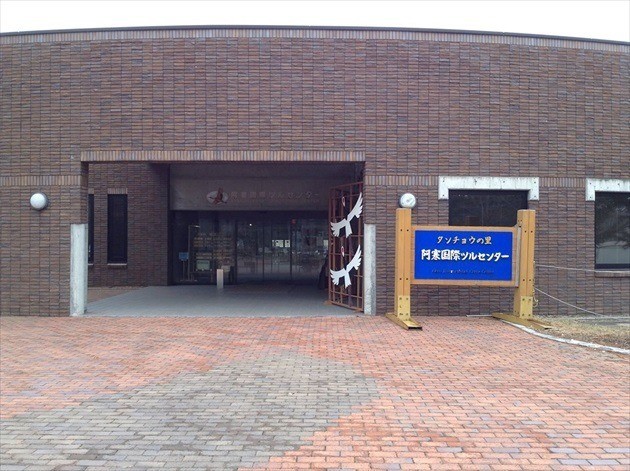
So, what exactly is inside the facility? Let's take a look.
2-1 Exhibition Corner

The exhibition area on the first floor uses panels, videos, and photo CDs to introduce the life, ecology, and relationship of Japanese cranes with humans.
The site includes information about cranes and computer quizzes, allowing children to learn while having fun.

The exhibit features red-crowned crane chicks that are approximately 7 to 10 days old, and chicks that are approximately one month old. Panels provide clear explanations.
Humans act as surrogate parents (by feeding) to raise endangered crane species or chicks that have lost their parents for some reason. This is a form of rearing that will allow them to return to the wild.

When people feed the cranes, they use arm puppets that resemble the parent cranes.
You can actually use an arm puppet to experience the action of picking up food with a knob that resembles a beak.
The start of feeding
The red-crowned crane, which was thought to be extinct.

Towards the end of the Taisho era, about 20 of them were confirmed to be living deep in the wetlands.
The Kushiro National Red-crowned Crane Conservation Society (established in 1935) then attempted to feed the cranes, and they gradually began to approach human settlements.
In the winter of 1948-1949, red-crowned cranes began to appear in Akan.
Then, in January 1950, several red-crowned cranes landed in the field of Sadajiro Yamazaki.
 Image source: Akan International Crane Center website.
When Mr. Yamazaki scattered corn intended for livestock, the cranes responded by pecking at the food, and from then on, they began to come every year.
In 1952, a severe snowstorm hit, and many red-crowned cranes were unable to find food in nature. Attempts were made to feed them at Hororo Elementary School in Tsurui Village, and it is said that the hungry cranes began to eat corn.
Since then, many people have continued the feeding activities. Kami-Akan, where Ms. Yamazaki, who initiated the winter feeding activities, was located, has become known as the "birthplace of artificial feeding."
The importance of protecting beautiful nature

Red-crowned cranes are omnivores.
Sometimes, the stomachs of deceased red-crowned cranes contain things like canned juice pull rings, glass shards, wire, fishhooks, and toxic lead pellets.
Even if it doesn't directly lead to death, it certainly contributes to the pollution of their habitat.
The fact that they were ingesting toxic lead from fishing weights and shotgun pellets is a serious problem.
Through the research, conservation, and outreach activities conducted at the center, we come to realize the importance of protecting Japan's beautiful natural environment, including wetlands and rivers.

Cranes belong to the family Gruidae, and there are said to be 15 species in 4 genera distributed throughout the world.

Red-crowned cranes are resident birds that live in the same place all year round. Their wingspan can reach over 2 meters!
What are the differences between males and females?

The only difference between males and females is the calls they make to each other as a couple.
Apparently, it's impossible to distinguish between males and females by appearance alone. The difference between males and females can be determined by the pitch, length, and number of notes in their voices.
In terms of their calls, the male holds its wings higher than the female, and the male starts with a single "coo" call, followed by the female making two or three "kak-kak" calls that overlap with the male's.
It sounds like "coo," "kak-kak," "coo," "kak-kak."
Cranes that have paired up call out to confirm their bond, to intimidate each other, or to declare their territory.
2-2 Video Corner

Learn all about the year-round life of a Japanese crane in this video corner (approximately 17 minutes)!
This is an original video showcasing the seasonal changes and lifestyle of the Japanese crane.
The cranes are vividly depicted on a 200-inch screen.
2-3 Kids' Space & Library

There's also a kids' play area with wooden toys for children to play with.
Through "interacting with wood" and wood education, we foster an understanding of the natural environment and cultivate a rich inner life.
Furthermore, you can freely browse field guides, photo collections, and research papers on cranes, including the Japanese crane, as well as other birds, and other literature and materials from both Japan and abroad.
3. Encounter beautiful red-crowned cranes in the outdoor enclosure.

There are three types of breeding cages outdoors.
At the "outdoor breeding grounds," you can observe red-crowned cranes in a near-natural environment throughout the year.
The red-crowned crane in the photo is named "Mook," and was raised by a surrogate parent.
The way she walks is so cute!
Taking photos is also OK.

These are Asahi and Sora, a couple who were united after a passionate love affair.

The tourists who were observing with us were also able to see the cranes up close and were very impressed.
If you would like a guide to explain things to you, please ask at the reception desk.
4. Capture breathtaking scenes with your camera at the "Red-crowned Crane Observation Center."
 Image source: Akan International Crane Center website.
The branch facility, the "Red-crowned Crane Observation Center," is open during the winter months from November to March.
Artificial feeding is carried out at the feeding area in front of the center.
At times, more than 300 wild red-crowned cranes fly in!
And apparently, up to 200 people visit daily, including photographers, birdwatchers, and tourists from all over the world. Some even come back every year to take pictures. (January and February are the busiest months.)
 Image source: Akan International Crane Center website.
During the 2 PM feeding, in addition to the red-crowned cranes, white-tailed eagles, Steller's sea eagles, and red foxes come to try and steal the food.
The battle between the defending red-crowned cranes and other wild animals trying to steal their prey is incredibly exciting! The way the cranes spread their large wings to intimidate their opponents is also very dynamic.
 Image source: Akan International Crane Center website.
The 2 PM feeding time is open to the public. 2 PM is also showtime!
You can see Japanese cranes up close. If you want to photograph Japanese cranes against a winter backdrop, winter is the best time to visit!
A "Red-crowned Crane Photo Contest" is also being held, so please feel free to share your best photos!
One of the delightful aspects is that you can admire the elegant figures of the red-crowned cranes from the warm interior of the annex.
There is a light meal and coffee corner inside the building. (Open from late December to early March.) You can enjoy a meal while watching the red-crowned cranes.
(For meals, you can also use the nearby "Red Beret" (leisure facility).)
5. Enjoy birdwatching in the biotope.
 Image source: Akan International Crane Center website.
A biotope stretches out behind the crane center. Biotope is a German word meaning "a place where various living things can live."
Within that environment, various living things coexist and interact with one another.
The landscape before you is a habitat for living creatures, created with the help of nature's power.
The biotope is closed during the winter due to the arrival of Japanese cranes, but it is open to the public during the summer, where you can see over 100 different species of birds!
You can also enjoy a stroll while listening to the birds singing.
If you'd like to enjoy birdwatching, please bring binoculars.
6. Access to the Akan International Crane Center

Directions and Access
・20 minutes by car from Kushiro Airport
・60 minutes by bus from Kushiro Station. Get off at the "Tancho no Sato" bus stop.
45 minutes by car from Lake Akan
<Spot Information: Akan International Crane Center (Gruss)>
address)40, 23-sen, Kami-Akan, Akan-cho, Kushiro City, Hokkaido
Phone) 0154-66-4011
Business hours: 9:00 AM - 5:00 PM
Closed days) Open all year round
HP) http://aiccgrus.wix.com/aiccgrus
Admission fee: 470 yen for adults (high school students and older)
Children: 240 yen (elementary and junior high school students)
Group discounts are available for groups of 15 or more.
*The branch facility, the "Red-crowned Crane Observation Center," is only open from November to March.
Final thoughts
We've shared the charms of the Akan International Crane Center, which can be enjoyed all year round.
What did you think.
Currently, the Japanese crane (Tancho crane) is found only in eastern Hokkaido, Japan.
If you meet her in person, you're sure to be captivated by her beauty.
Please also check out these related articles.
-

- A castle from "Frozen" is in Asahikawa!? Feel like a princess at the "Snow Museum"!
-

- Enjoy snow activities easily! Tokachi Ecology Park Winter Festival
-

- [Rumoi Sightseeing] Sunsets and seafood! We'll show you how to enjoy the port town of Rumoi♪
-

- Five long-established mochi shops beloved by Hakodate residents [Nostalgic tastes of Hakodate]
-

- If you're looking for soft serve ice cream around Abashiri, try these! 7 delicious options [Fresh and tasty]
-

- Enjoy stunning scenery and flowers while cycling! The allure of the Furano-Biei Cycling Road
-

- A leisurely trip around Hakodate by streetcar! A model itinerary for exploring Hakodate by streetcar.
-

- Jingisukan Hot Pot Museum | A museum dedicated solely to Jingisukan hot pots has opened in Iwamizawa!

Hokkaido from all over Japan! Find affordable Hokkaido package tours here.

Make your trip even more enjoyable! Book your Hokkaido local experience tour here.

Combine flights and hotels freely for great deals! Dynamic Packages
Introducing our sister site (please check it out if you're interested)


 Choose from area
-
 Sapporo/Jozankei
-
 Hakodate, Southern Hokkaido, Okushiri
-
 Northern Hokkaido, Wakkanai, Rishiri and Rebun Islands
-
 Asahikawa/Sounkyo
-
 Eastern Hokkaido (Abashiri, Kitami, Shiretoko)
-
 Kushiro, Akan, Kawayu, Nemuro
-
 Tokachi-Hidaka
-
 Furano, Biei, Tomamu
-
 Noboribetsu and Lake Toya
-
 Chitose, Lake Shikotsu, Yubari
-
 Otaru, Rusutsu, Niseko

 Search by trending tags
Popular article ranking
Yesterday
1 months


