

 List of Articles

 Search by Area
 Book your trip
 Tour
 Local Experience
 Rental Car
 Hotels
 Golf
 VILLA
 Search articles
 Tour search

Want to travel by car? A summary of ferry information from Honshu to Hokkaido.
-

- All of Hokkaido
-

- Last updated: September 23, 2024
If you're traveling with your own car, then taking a ferry is definitely the best option.
But which ports do the ships depart from and to? How many trips are there? Is the ship comfortable? And how much does it cost?
It's also true that there are many things that make me anxious.
Since checking each ferry company's website individually is time-consuming and troublesome, this time we're revealing a comparison and features of each route.
I hope this will be helpful for everyone planning a wonderful trip to Hokkaido.
*This article is based on information as of June 2024. For detailed and up-to-date information on each ferry, please check the respective ferry company's website.
 Table of contents
1. Overview of ferries to Hokkaido
2. If you're going by ferry from Tokyo/Kanto
2-1. From which port does it depart?
2-2. How many and what are the times?
2-4. What are the ship's facilities?
3. If you're going by ferry from the Chubu/Tokai region
3-1. From which port does it depart?
3-2. How many trains and what are the schedules?
3-4. What equipment does the ship have?
4. If you're going by ferry from Kansai
4-1. From which port does it depart?
4-2. How many and what are the times?
4-4. What equipment does the ship have?
5. If you're going by ferry from Tohoku
5-1. From which port does it depart?
5-2. How many and what are the times?
1. Overview of ferries to Hokkaido
~List of ferries from Honshu~
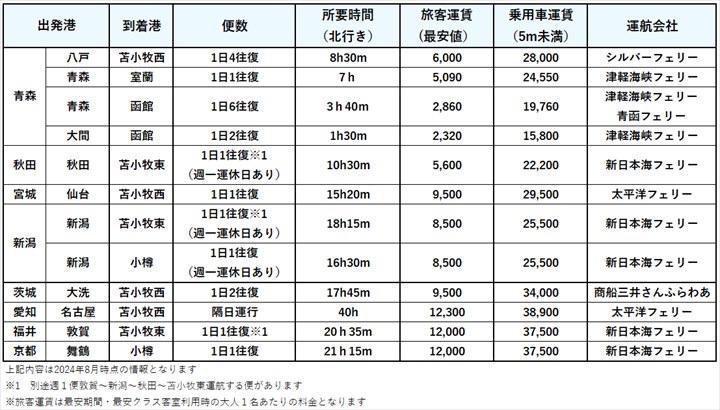
~List of shipping companies~
・Mitsui O.S.K. Lines Sunflower
・太平洋フェリー
・新日本海フェリー
・Tsugaru Kaikyo Ferry
・Seikan Ferry
・Amanecer
2. If you're going by ferry from Tokyo/Kanto
2-1. From which port does it depart?
 Photo by Flickr: Fisherman and Sunflower ferry / isinoid
There is only one departure point in the Kanto region: Oarai in Ibaraki Prefecture.
If you're going to Oarai Port by car, the nearest interchange is Mito-Oarai on the Joban Expressway, and it takes about 10 minutes from the highway exit to the Oarai Port Ferry Terminal.
If you're taking the Higashi-Kanto Expressway, it's about a 1-hour drive from the Itako Interchange.
From Oarai, Mitsui O.S.K. Lines' Sunflower operates a ferry service to Tomakomai West Port.
2-2. How many and what are the times?
 Photo by Flickr: Sunflower Sapporo @ Oarai Port / A_CUVE
There are 12 flights per week, including late-night and evening flights, with a total travel time of approximately 18 hours.
The evening ferry departs around 19 PM and arrives the following day around 1 PM. The late-night ferry departs around 2 AM and arrives around 20 PM on the same day.

While it's a late-night ferry, allowing you to prepare after work, you need to be prepared to spend the entire day at sea.
2-3. Fees
All shipping companies have seasonal price fluctuations, and Mitsui O.S.K. Lines Sunflower divides its pricing into five time slots throughout the year.
Please note that the fare calendars differ slightly between northbound and southbound journeys.
Passenger fares vary by class, with evening flights and top-tier suites costing between 54,000 and 77,000 yen, while the lowest-tier tourist class costs between 9,500 and 21,000 yen.
*Passenger fares are per person.
*Children under 12 years old or attending elementary school will be charged 50% of the adult fare. One preschool-aged child sleeping in the same bed as an adult is free of charge per adult.
*Cabin class settings differ between evening and late-night flights.
If you bring a car on the ferry, you will need to pay a passenger car fare. For example, if the car is less than 5 meters long, the fare will range from 34,000 yen to 49,000 yen, and this amount also varies depending on the date of travel.
The passenger car fare includes the cheapest class passenger fare for one driver, but additional charges may apply depending on the cabin type used.
In addition, various discounts are available, including student discounts, group discounts, internet booking discounts, and return trip discounts.
*Excludes certain periods
In addition, there are other great deals such as bus packages that include travel between Tokyo and Oarai, and Tomakomai and Sapporo, starting from 9,990 yen, as well as packages that include accommodation in Hokkaido. If you are interested, please check out the official website.
2-4. What are the ship's facilities?
The evening ferry (Sunflower Sapporo/Furano) is a large ferry exceeding 13,000 tons and has more extensive facilities compared to the overnight ferry (Sunflower Daisetsu/Shiretoko).
First, one of the biggest differences I want to mention is that there are no elevators on the passenger floors of late-night flights.
If you have difficulty going up and down stairs, we recommend using the evening service.
The evening ferry is equipped with a restaurant and shop, as well as a spacious observation bath, a marine theater, and an observation lounge.
The restaurant primarily operates as a buffet, but may offer set menus in limited quantities.
On the other hand, the overnight service is more casual, and the slightly smaller onboard vessels are more practical, emphasizing the ferry as a means of transportation.
The only room types available are deluxe and casual. There are vending machines selling snacks and a small shop, but it's a good idea to prepare any necessary food, toiletries, etc. before arriving at the port.
For inquiries, please visit the Mitsui O.S.K. Lines Ferry website. https://www.sunflower.co.jp/
3. If you're going by ferry from the Chubu/Tokai region
3-1. From which port does it depart?
 Photo by Flickr: Passing a ferry from Sendai to Nagoya / nimame
The departure ports are Nagoya, Niigata, and Tsuruga (Fukui Prefecture).
From Nagoya, Pacific Ferry operates only one route, via Sendai to Tomakomai.
Meanwhile, flights departing from Tsuruga will go to Tomakomai.
There is one flight per week that goes via Niigata and Akita.
From Niigata Port, there are direct services to Otaru and services that go via Akita before arriving in Tomakomai.
Both Niigata Port and Tsuruga Port are operated by Shin Nihonkai Ferry.
The Sea of Japan is not usually rough in the summer, but it can get rough in the winter, so many people who get seasick easily choose to use the Pacific side of the sea.
3-2. How many trains and what are the schedules?

There are five flights a week between Niigata, Akita, and Tomakomai.
The Azalea and Shirakaba are currently operating, and the journey takes approximately 20 hours. If the ship departs at 10:30 AM, it will arrive at 4:30 AM the following day. There is also a weekly service between Tsuruga, Niigata, Akita, and Tomakomai, also operated by the Shirakaba.
The journey takes 34 hours. That means we depart at 6 PM and arrive at 4:30 AM two days later.
There is one train per day between Tsuruga and Tomakomai, either the Suzuran or Suisen, which takes 21 hours.
The ship departs at 1:00 AM and arrives in Tomakomai at 8:00 PM. The journey from Niigata to Otaru takes approximately 18 hours.
We depart at 10:30 AM and arrive in Otaru at 4:30 AM the following day. Yukari and Lilac will be connecting the two.
The longest route I'll be introducing this time is Nagoya to Sendai to Tomakomai.
The distance is approximately 1,300 km. Departing at 7 PM, the ship will make a three-hour stopover in Sendai and arrive at 11 AM two days later.
There is only one flight every two days, because the one-way trip takes approximately 40 hours.
You will be spending more than a day and a half at sea.
3-3. What are the fees?
Shin Nihonkai Ferry operates in two main periods.
 Photo by Flickr: ferry Shirakaba @ Niigata port / tsuda
The price will differ between the winter season and other times of the year.
Fares between Niigata and Tomakomai range from 6,480 yen for Tourist J class to 40,110 yen for a Suite class.
Private car rentals range from 16,970 yen to 28,800 yen.
The price is the same even if the destination is Otaru.
The fare for flights between Tsuruga and Tomakomai is the same whether it's a direct flight or a flight via Niigata or Akita.
From Tourist J at 9,570 yen to Suite at 54,000 yen, there are a variety of options to suit your budget and desired amenities.
The fare from Nagoya to Tomakomai ranges from 10,800 yen for second class to 71,000 yen for a Royal Suite.
This route is characterized by its detailed seasonal divisions, which are divided into three periods.
Children under 12 get half price. Suites include meals.
Regarding discounts, each company offers a variety of discounts, and the Japan Sea route offers discounts of 30% and 25% respectively during the spring and summer seasons, although these are limited to passengers aged 55 and over.
Additionally, there is a family discount system where elementary school children can enter for free.
On the other hand, the Pacific route offers early bird discounts, with up to 50% off for bookings made 28 days or more in advance.
The inability to change reservations is a drawback, but if your plans are firmly set, you can enjoy a very affordable trans-Pacific cruise.
3-4. What equipment does the ship have?
 Photo by Flickr: ferry AZALEA / tsuda
Many of the routes are over 1,000 km one way, so the ships are well-equipped and have plenty of comfortable amenities.
A distinctive feature of Shin Nihonkai Ferry is that its restaurant is a cafeteria style with a wide variety of à la carte options.
Pacific Ferry offers a buffet-style meal with steaks, various desserts, and salads, ensuring that passengers won't get bored during their long voyages.
The facility also includes a theater lounge and a large public bath with a view.
You can enjoy a relaxing bath while watching the rising sun or the setting sun.
Some of Shin Nihonkai Ferry's ships are equipped with saunas and sports corners, so you can definitely enjoy a long sea voyage.
▼▼1-day pass: 1,980 yen / Click here for details on usable facilities and menus▼▼

4. If you're going by ferry from Kansai
4-1. From which port does it depart?

The Kansai route is said to be between Maizuru and Tsuruga, but since I introduced Tsuruga in the Chubu region section, I will introduce the route between Maizuru and Otaru in Kyoto Prefecture here.
This is a historic shipping route that has been used by Kitamae ships since the Edo period.
It takes about an hour and a half to get to Maizuru by taking the Chugoku Expressway and then the Maizuru Expressway or the Kyoto Jukan Expressway.
4-2. How many and what are the times?

Shin Nihonkai Ferry operates the Hamanasu and Akashiya ferry services once a day.
If you leave Maizuru at 12:30 AM, you will arrive in Otaru at 8:45 PM.
With a weight exceeding 16,000 tons and a top speed of 30.5 knots (approximately 56 km/h), this high-speed ferry can reach Otaru in less than a day, even on routes exceeding 1,000 km.
A speed of 30 knots is far faster than that of battleships during World War II.
4-3. What are the fees?
Shin Nihonkai Ferry has two seasonal classifications: A and B. Class A runs from the beginning of January until before Golden Week, and the fares are slightly cheaper.
The room categories are Tourist A and S, State B and Deluxe A for families and groups, and the top-of-the-line Suite.
For period A, prices range from 9,570 yen (Tourist A) to 50,910 yen (Suite).
For period B, the price will be between 10,800 yen and 54,000 yen.
Children (up to 12 years old) receive a 50% discount on their rates. Meals are included in the suites.
Various discounts are available, including a 10% discount on round-trip fares, a summer-only family discount, and discounts specifically for those aged 55 and over, making them easy to use.
Regarding vehicles, the price is 31,370 yen for period A and 35,900 yen for period B (both for vehicles under 5 meters in length).
4-4. What equipment does the ship have?
There are two types of restaurants: a grill offering upscale course meals and a more casual restaurant.
A cafe is also available.
The grill restaurant offers set menus by advance reservation. The restaurant is a cafeteria-style restaurant serving breakfast, lunch, and dinner.
All basic comfort amenities are above average, and with facilities like a large public bath and a free theater, you can enjoy a long cruise without getting bored.
5. If you're going by ferry from Tohoku
5-1. From which port does it depart?
In the Tohoku region, the ferry departs from three ports: Sendai, Akita, and Hachinohe, before heading to Tomakomai.
There are flights from Aomori/Oma to Hakodate.
Of these, the ferries across the Tsugaru Strait are operated by two companies, with approximately 18 trips per day, making it a major artery of the sea. For more details , please refer to the information provided here .
The ferry route from Hachinohe to Tomakomai is popular as it directly connects Tohoku and central Hokkaido.
Furthermore, Silver Ferry announced the opening of new routes between Miyako Port in Iwate Prefecture and Muroran Port in Hokkaido (March 7, 2016)!
The opening is scheduled for June 2018. Miyako City is developing as a logistics hub as part of its post-earthquake reconstruction. There are also plans for a direct expressway connection between Miyako City and the Tohoku Expressway, so we can look forward to it!
5-2. How many and what are the times?
 Photo by Flickr: Lounge show on the Pacific Ferry "Kitakami" / houroumono
The Sendai-Tomakomai route is operated by Pacific Ferry, with the Kitakami making one sailing per day. In addition, the Ishikari and Kiso make one sailing every two days from Nagoya to Sendai.
We will depart Sendai around 7 PM and arrive in Tomakomai at 10 AM the following day.
The total time will be approximately 15 hours.
The Akita-Tomakomai route operated by Shin Nihonkai Ferry has departure times that vary greatly depending on the season, but the journey takes approximately 10 hours and there is one sailing per day.
Silver Ferry operates between Hachinohe and Tomakomai. There are four departures a day: morning, afternoon, evening, and late night. Of these, the evening and late night departures arrive in Tomakomai the following day.
These ferries are relatively small, ranging from 7,000 to 10,000 tons. The journey takes approximately 7.5 to 8.5 hours.
5-3. What are the fees?
 Photo by Flickr Kitakami / houroumono
Among the areas on the Pacific coast of the Tohoku region, Hachinohe offers the most affordable fares.
The second prize is 5,000 yen. Even the first prize is reasonably priced at 12,500 yen.
If the vehicle is less than 5 meters in length, the fee will be 25,000 yen.
The price does not change depending on the season.
The fare for second class from Sendai to Tomakomai is 8,300 yen (7,200 yen for Kitakami) during period A. The highest class Royal Suite costs 59,000 yen during the high season (the highest grade on Kitakami is a Suite at 39,000 yen), and during period A it is 47,500 yen (30,000 yen for a Suite on Kitakami). Vehicles under 5m cost 26,500 yen.
Regarding transportation, considering the highway tolls to Hachinohe and the cost of gasoline, Sendai seems like a more economical option.
The Akita to Tomakomai route starts at 4,530 yen for Tourist J Class A, with seven price tiers up to 24,170 yen for a suite.
During the high season (period B), prices range from 5,040 yen for a Tourist J class to 27,260 yen for a suite.
For vehicles under 5 meters in length, the fee is 18,410 yen during period A and 21,090 yen during period B.
5-4. What are the ship's facilities?
 Photo by Flickr: Hachinohe Ferry Terminal / sendaiblog
In terms of facilities, the Ishikari and Kiso on the Sendai-Tomakomai route, and the Azalea and Shirakaba on the Akita-Tomakomai route, are well-equipped, as they are used on long-distance routes.
The Hachinohe-Tomakomai route is simpler and more casual, as the emphasis is on the ferry as a means of transportation.
There are no restaurants or other facilities; only vending machines are available.
Additionally, some vessels have small bathrooms rather than panoramic ones.
While the Azalea and Shirakaba aren't particularly fast, they boast hulls exceeding 20,000 tons and offer plenty of entertainment options.
The deck even has a jacuzzi. However, swimwear is required.
Final thoughts

What did you think.
Depending on your travel plans, you will also need to choose a ferry.
Taking a ferry from your local area will take more time, which means you'll have to sacrifice some of your travel time.
Also, the time of arrival—whether in the morning or evening—will affect your travel plans.
Your choice will depend on whether you view the ferry as a means of transportation or as something to enjoy the sea voyage itself.
Furthermore, you should choose between the Pacific Ocean and the Sea of Japan depending on the season.
Planning the trip itself can be considered part of the enjoyment.
I hope this article will help you plan a wonderful trip to Hokkaido by car.
Please also check out these related articles.
-
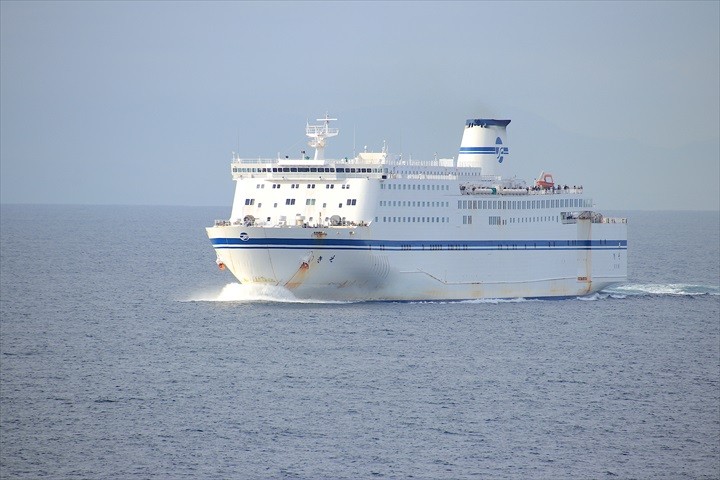
- A leisurely 40-hour voyage from Nagoya to Hokkaido! A travelogue of the "Pacific Ferry"
-

- Where can I buy SNOWS? Have you tried this popular winter-only treat that's sure to sell out?
-

- Morihiko 14 Store Report! Enjoy their carefully selected coffee and unique cafe concepts.
-

- What exactly is the mysterious and enigmatic creature known as "marimo"?
-

- Six must-try sakes from Hokkaido, the northern land of Japan.
-

- Want to go camping in the great outdoors? Here are 7 recommended campsites in Hokkaido!
-
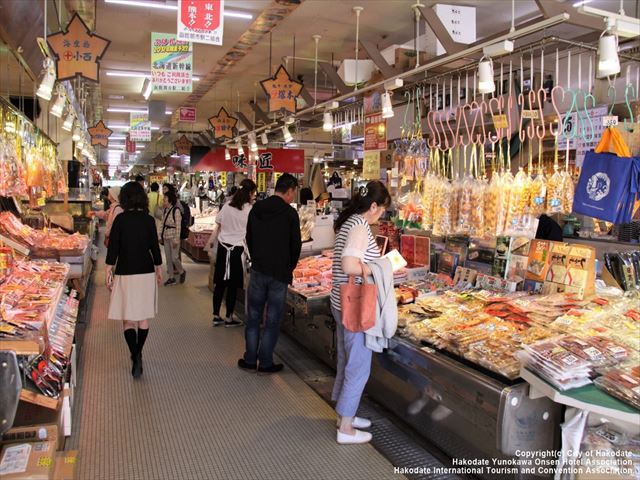
- 8 Markets in Hokkaido Where You Can Enjoy Seafood
-

- Discovering the wonders of winter in Hokkaido: [Winter Lifestyle in Hokkaido]

Hokkaido from all over Japan! Find affordable Hokkaido package tours here.

Make your trip even more enjoyable! Book your Hokkaido local experience tour here.

Combine flights and hotels freely for great deals! Dynamic Packages
Introducing our sister site (please check it out if you're interested)


 Choose from area
-
 Sapporo/Jozankei
-
 Hakodate, Southern Hokkaido, Okushiri
-
 Northern Hokkaido, Wakkanai, Rishiri and Rebun Islands
-
 Asahikawa/Sounkyo
-
 Eastern Hokkaido (Abashiri, Kitami, Shiretoko)
-
 Kushiro, Akan, Kawayu, Nemuro
-
 Tokachi-Hidaka
-
 Furano, Biei, Tomamu
-
 Noboribetsu and Lake Toya
-
 Chitose, Lake Shikotsu, Yubari
-
 Otaru, Rusutsu, Niseko

 Search by trending tags
Popular article ranking
Yesterday
1 months


