

 List of Articles

 Search by Area
 Book your trip
 Tour
 Local Experience
 Rental Car
 Hotels
 Golf
 VILLA
 Search articles
 Tour search
The secret behind the exquisite "Sunset of Lake Mashu" mango, grown in the harsh northern climate.
-

- Post
-

- Last updated: September 10, 2018
 Table of contents
1. Mangoes in Teshikaga Town, at the foot of Lake Mashu?
2. Cultivation using geothermal heat from hot springs
3. The secret to the deliciousness of the sunset over Lake Mashu
A landscape covered in pure white snow.
In the freezing air, even the slightest moisture present turns into diamond dust, sparkling in the sunlight... This is the kind of scenery that unfolds in winter in Teshikaga town in eastern Hokkaido.
I heard that mangoes, a quintessential tropical fruit, are being cultivated in this town despite the extreme cold, so I went to investigate and uncover the secret.
<Table of Contents>
1. Mangoes in Teshikaga Town, at the foot of Lake Mashu?
2. Cultivation using geothermal heat from hot springs
3. The secret to the deliciousness of the sunset over Lake Mashu
4. Where can I eat it?
5. About ordering online
Final thoughts
1. Mangoes in Teshikaga Town, at the foot of Lake Mashu?
Teshikaga Town is located in the heart of eastern Hokkaido and is nationally famous for Lake Mashu, which boasts the clearest water in Japan.
Approximately two-thirds of the town's area is included in the Akan Mashu National Park, and because visitors can enjoy the magnificent nature throughout the four seasons, it is a popular tourist town that attracts many tourists every year.
 (Photo: Lake Mashu in a sea of clouds)
While Lake Mashu tends to attract the most attention, Teshikaga Town actually encompasses the entire area of Lake Kussharo, Japan's largest caldera lake.
Not only is it beautiful and majestic, but the power of the earth created by the caldera is also manifested as a blessing of hot springs, allowing you to enjoy various types of hot spring water throughout the town.
 (Photo: Lake Kussharo in winter)
 (Photo: Mt. Iwo and white azaleas)
The population of Teshikaga Town is approximately 7,500 people.
While the natural environment is harsh, with summer temperatures exceeding 30°C and winter temperatures dropping to nearly -30°C, resulting in a yearly temperature difference of almost 60°C, its greatest appeal lies in its abundant natural resources and beautiful surroundings.
Having heard that mango cultivation has recently begun in Teshikaga town, I visited the farm of "Farm People," the company that cultivates mangoes, to find out the secret: "How on earth are they growing mangoes in such an extremely cold place?"
2. Cultivation using geothermal heat from hot springs

Our guide was Yohei Murata, who manages the farm.
After a brief greeting, we were first guided into the row of houses.

Currently, there are 30 such greenhouses neatly lined up on the farm.
As expected from a place that grows tropical fruits, the plastic covering is double-layered. When you lift the plastic and step inside...

Inside, there was a faintly sweet mango scent, and a vibrant green burst of fresh air greeted me.
It's below freezing outside, but it's very warm inside the greenhouse, around 20-30°C, making you forget you're in a northern region.
The secret to this warmth is geothermal energy from the hot springs. They use the abundant hot spring water to keep the inside of the greenhouse warm.
 (Photo: Hot spring water is stored in tanks buried underground.)
The hot spring water is 82-85°C. Once stored in a tank, the water is sent to each of the 30 greenhouses.


The hot spring water is used for heating in each building using these machines, which automatically regulate the temperature inside the building.

To prepare for situations where the temperature is insufficient or unforeseen circumstances, a heavy oil tank has been installed on the premises as a "backup," and a heavy oil heating system is also in place, but apparently it hasn't been used even once this season.
"If we were to heat all the buildings with heavy oil heating, the heating costs alone would amount to about 300 million yen per year!" said Murata.
If that were to happen, it would not only be unfriendly to the global environment, but it would also become completely unsustainable from a cost perspective. That's why mango cultivation in northern regions is only possible because of the abundance of hot springs.
3. The secret to the deliciousness of the sunset over Lake Mashu
However, even with abundant hot springs, a system that automatically controls the temperature, and 30 warm greenhouses, cultivating mangoes in the northern regions remains challenging.
The farm opened in 2011, but Mr. Murata says, "For the first two years, we were mostly feeling our way through things, and the temperature trends are different every year, so we've made pretty much every kind of mistake imaginable."
The trial and error that went into growing them has finally culminated in the delicious mangoes we see today.

Approximately 50 mango trees are planted in each greenhouse.
Here, with the exception of one building where plants were experimentally planted directly in the ground, all plants are grown in pots.
The pots in which the mango trees are planted are made of a special material that is soft, permeable to water, and yet durable.
They say that growing plants in pots makes it easy to adjust the amount of water and limit the height of the plants.
Another advantage is that it allows you to move trees without damaging them.

Currently, there are approximately 1,600 trees being grown throughout the entire farm.
The current record for the highest harvest is 2 fruits, but as the trees age and cultivation techniques become more established, they expect to eventually harvest 4 to 5 fruits.

However, many people must be wondering why mangoes are grown in this northern region... Wouldn't it be easier to grow mangoes in Kyushu or Okinawa?
The answer, surprisingly, lies in the cold here.
"Mangoes can be harvested three times every two years. However, they need a temperature of around 20°C to bloom, and in Kyushu and Okinawa, the main mango-growing regions, the summers are too hot for the trees to flower. Here, however, the summers are cool, so the trees can flower even in the summer. Mango trees that flower in August will be ready for harvest around December or January."
During this time of year in winter, the only mangoes harvested domestically are those from Hokkaido.
And currently, Farm People's farm is the only place in Hokkaido that is harvesting this many mangoes at this time of year.
These are very rare, domestically grown mangoes from winter.

The photo shows a small mango flower.
When fully grown, a single plant can produce around 3,000 tiny flowers, but apparently, you should leave only one and prune the rest.
A single, carefully selected flower will eventually grow into a large mango.
I visited for the interview in December, and the flowers that bloomed at that time will be ready for harvest around April or May.
Of course, even after the flowers bloom, we continue to pay attention to each and every one of them, hanging them up as they grow, covering them with nets, and attaching silver plates to encourage coloring. We can't take our eyes off them for even a single day.
"Before I started cultivating them, I thought they would grow if I just kept the temperature constant and watered them. But it was completely different! I can't take my eyes off them, so now I'm living and sleeping at the farm and can't go anywhere."
That's what Mr. Murata said.
Because it's such a laborious process, the joy of finally achieving a successful harvest is truly immense.

Mango cultivation in this northern region started with no prior experience, but we were taught one of the unique cultivation methods found only here.
That involves using kelp from Hokkaido as fertilizer.
It seems that the minerals from the seaweed dissolve into the soil, dramatically changing the taste of the harvested mangoes.

The mangoes on the farm are the Irwin variety, also known as "apple mangoes." When they ripen, they fall naturally and are collected in nets.
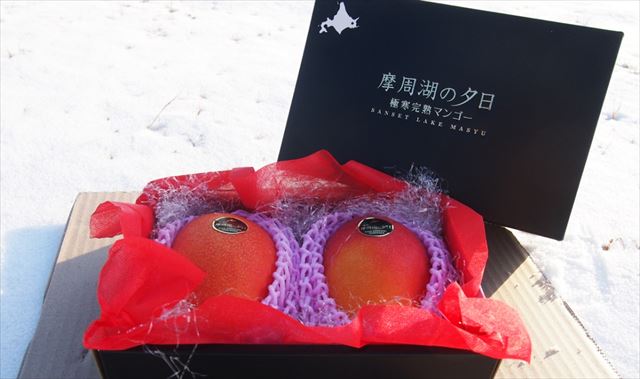
The mangoes, which have overcome various hardships and ripened to perfection, are shipped to all parts of the country under the product name "Sunset over Lake Mashu."
As the name suggests, it's a brilliant red, and its beauty is truly breathtaking.
4. Where can I eat it?
Mangoes that were finally harvested after overcoming numerous hardships.
Within Teshikaga town, you can purchase boxed versions at the direct sales store at the roadside station, Mashu Onsen.


For those lucky enough to get their hands on this box of mangoes, we asked for their recommended ways to eat them.
The best way to eat it is to cut it and eat it as is, but they also say it's good mixed with yogurt or something similar.
They also mentioned that when you eat it, be sure to try it at room temperature.
If you chill it too much in the refrigerator, you won't be able to enjoy its natural sweetness, so if you do chill it, it's best to just lightly cool the outside right before eating.
The box includes illustrated instructions on how to cut the mango, so even first-timers can do it with ease.

Now, when I actually tasted "Sunset over Lake Mashu," I was surprised by how creamy and smooth it was.
Furthermore, it has none of the bitterness or astringency typical of mangoes, making it refreshing and recommended even for those who don't like mangoes.
In addition to the above, you can also enjoy processed products made with mangoes in Teshikaga town.
First up is "Mori no Hall," a cafe located in front of Kawayu Onsen Station.

This shop is bustling with customers every day, as it offers exquisite sweets made with carefully selected ingredients. However, the most popular cake, which sells out as soon as it's made, is the "Mango Tart."

With its crispy tart crust, melting vanilla cream, and generous layers of fragrant mango, this is truly an exquisite treat.
This limited-edition cake can only be made during mango season, so if you definitely want to try it, please make a reservation at the shop before you go.
Forest Hall
Address: 2-chome, Kawayu Station Front, Teshikaga-cho, Kawakami-gun, Hokkaido
Phone: 015-483-2906
Opening hours: 9:30 AM - 6:00 PM (until 5:00 PM in winter)
*Forest meals are available from 11:00 to 16:00.
Closed on Tuesdays and the 2nd and 4th Mondays of the month.
Boxed mangoes can be purchased at the "Michi-no-Eki Mashu Onsen Direct Sales Store".


Mango juice is also sold at the direct sales store.

This mango juice boasts a rich aroma and a light, refreshing taste. Made with 100% mango juice inspired by the sunset over Lake Mashu, it's a truly luxurious drink. It's available year-round, so please be sure to try it when you stop by the roadside station!
Roadside Station Mashu Onsen (Direct Sales Store)
Address: 3-5-5 Yunoshima, Teshikaga-cho, Kawakami-gun, Hokkaido
Phone: 015-482-2288
営業時間:8:00~18:00(11月~4月は、9:00~17:00)
Regular closing days: Open every day (closed December 30-31 and January 2-3)
5. About ordering online
The precious Teshikaga-grown mango, "Sunset over Lake Mashu," is also available as a thank-you gift for those who make a "hometown tax donation" to Teshikaga Town.
http://www.town.teshikaga.hokkaido.jp/05machizukuri/15tyousei/furusatonouzei_tokuten.html
Mangoes from Teshikaga are currently harvested three times a year: from December to January, from April to May, and in smaller quantities around October. Check the Furusato Nozei (hometown tax donation) website to find out when mangoes are in season!
Furthermore, they are shipped as premium mangoes to famous department stores throughout Japan.
If there's a fruit shop near you, you might come across it.
Final thoughts
This time, we introduced "Mashu Lake Sunset," a rare mango variety harvested in winter in northern regions.
Teshikaga Town is attractive for its abundant nature and hot springs. Please take your time to enjoy the magnificent natural scenery.
The town boasts several famous hot springs, including Mashu Onsen, Kussharo Onsen, and Kawayu Onsen.
Enjoy delicious mangoes and relax in nature and hot springs! Have a time that is gentle on both your mind and body.
Please also check out these related articles.
-

- I want to go see this! 8 of the most popular annual events in Hakodate and the surrounding area.
-

- Four recommended spots in and around the natural flower garden "Koshimizu Wildflower Garden"
-

- Enjoy Hokkaido to the fullest with a rental car! 5 recommended scenic mountain passes by Hokkaido residents
-

- A symbol of Hokkaido! The charm and ways to enjoy the Red Brick Government Building (former Hokkaido Government Office building)
-

- A magical night in Hakodate! Hakodate illuminations & winter events
-

- Lake Toya Nakajima Island Trekking Experience Report ~Exploring the Nakajima Island Loop~
-

- Five long-established mochi shops beloved by Hakodate residents [Nostalgic tastes of Hakodate]
-

- Things you should know when renting a car at New Chitose Airport!

Hokkaido from all over Japan! Find affordable Hokkaido package tours here.

Make your trip even more enjoyable! Book your Hokkaido local experience tour here.


Combine flights and hotels freely for great deals! Dynamic Packages
Introducing our sister site (please check it out if you're interested)


 Choose from area
-
 Sapporo/Jozankei
-
 Hakodate, Southern Hokkaido, Okushiri
-
 Northern Hokkaido, Wakkanai, Rishiri and Rebun Islands
-
 Asahikawa/Sounkyo
-
 Eastern Hokkaido (Abashiri, Kitami, Shiretoko)
-
 Kushiro, Akan, Kawayu, Nemuro
-
 Tokachi-Hidaka
-
 Furano, Biei, Tomamu
-
 Noboribetsu and Lake Toya
-
 Chitose, Lake Shikotsu, Yubari
-
 Otaru, Rusutsu, Niseko

 Search by trending tags
Popular article ranking
Yesterday
1 months


