

 List of Articles

 Search by Area
 Book your trip
 Tour
 Local Experience
 Rental Car
 Hotels
 Golf
 VILLA
 Search articles
 Tour search
A walk through the old days of Otaru: A recommendation for a stroll along the former Temiya Line.
-

- Post
-

- Last updated: September 10, 2018
 Table of contents
1. The former Temiya Line played a significant role in the development of Hokkaido.
1-1. Active in transporting supplies
1-2. Why was the railway line abandoned?
2. Highlights of the former Temiya Line
2-1. You can walk along the preserved former Temiya Line.
2-3. The passage of history is visible.
3. Recommended cafes and gourmet spots along the railway tracks!

In Otaru City, the former Temiya Line, a railway line that played a significant role in the development of Otaru and Hokkaido, is preserved.
Although the railway line is not currently in operation, you can walk along it.
So, in this article, I'd like to introduce the former Temiya Line, some points of interest when walking along the tracks, and some recommended cafes and restaurants along the railway line.
It's the perfect place to take a break while walking along the old Temiya Line.
The fact that you can still walk along the former railway tracks is very rare, so if you ever visit Otaru, be sure to check it out.
Table of Contents:
1. The former Temiya Line played a significant role in the development of Hokkaido.
1-1. Active in transporting supplies
1-2. Why was the railway line abandoned?
2. Highlights of the former Temiya Line
2-1. You can walk along the preserved former Temiya Line.
2-2. Site of Irouchi Station
2-3. The passage of history is visible.
2-4. Otaru City Museum
3. Recommended cafes and gourmet spots along the railway tracks!
3-1. Daijinmon Irouchi Main Store
3-2. Okonomiyaki Hana
3-3. Freelance
3-4. Ippuku Soba Restaurant
Final thoughts
1. The former Temiya Line played a significant role in the development of Hokkaido.
1-1. Active in transporting supplies

In 13, the Horonai Railway (between Otaru/Temiya and Sapporo) was opened as one of the important projects for the development of Hokkaido, becoming the first railway line in Hokkaido.
The Horonai Railway transported pioneering supplies and other goods from Otaru Temiya to Sapporo, and in 1882 (Meiji 15), it was completed all the way to Mikasa Horonai, where the Horonai coal mine was located, marking the beginning of full-scale coal transportation.
After that, they continued to supply coal, contributing to Japan's development.
In addition to transporting coal, we also transported animal feed, cement, and flour.
In 39, the "Railway Nationalization Law" was promulgated, leading to nationalization. In 42, the names of the railway lines were unified, and the section from Otaru (present-day Minami-Otaru) to Temiya was renamed the "Temiya Line."
1-2. Why was the railway line abandoned?

The main reason the Temiya Line was discontinued is that, although it had previously played an important role in transporting goods, the rise of truck transport and other methods made them more convenient than rail, resulting in a decrease in the number of shippers using the line.
In 1985, all shippers terminated their contracts, leaving no reason for the line to continue. As a result, on November 5th of the same year, the line closed its doors after a long 105-year history.
2. Highlights of the former Temiya Line
2-1. You can walk along the preserved former Temiya Line.

The former Temiya Line, which has a rich history of Hokkaido's development, is not only a valuable railway line but also a place where you can actually walk along the tracks.
Since bicycles and other vehicles are not allowed, you can take your time and enjoy a leisurely stroll.
The well-maintained starting point on the Minami-Otaru Station side is at the site of the former bridge piers on Sushi Street.
From there, the railway tracks stretch straight ahead, and there are information boards with explanations at various points, so you can take a stroll while learning about history and imagining what it was like back then.
Looking at the railway tracks, the trees laid between them are old, and plants are growing in the gaps between the tracks.
Among the plants growing there are dandelions in bloom, and seeing the dandelions in full bloom allows one to imagine what the situation was like back then, perhaps wondering if they used to grow along the railway tracks as well.
2-2. Site of Ironai Station
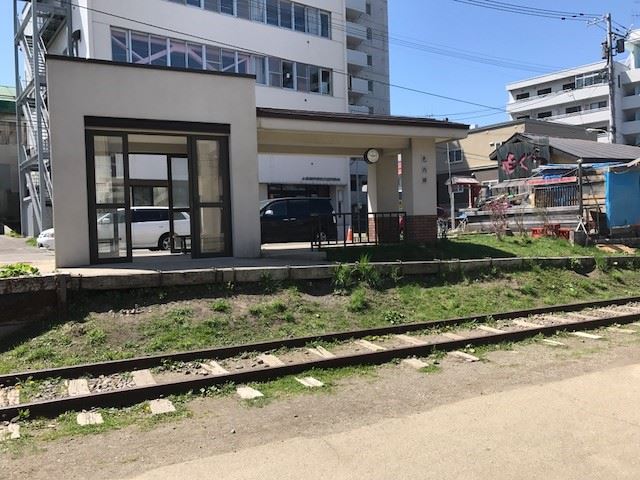
If you walk along the railway tracks, you will arrive at the site of the former Ironai Station.
Let's look back at the history of the former Irouchi Station site.
It was established in August 1912 as "Irouchi Temporary Station" (a passenger-only station).
The station was closed for the first time in 1920, after operating from 1914, but it was revived in 1943 as "Irouchi Station".
However, it was suspended again after only about five months.
It was later revived in 1949 as "Irouchi Temporary Station," but with the discontinuation of passenger service on the Temiya Line in 1962, Irouchi Station was completely abolished.
Even now, the platform of Irouchi Station still remains.
Although there are no buildings on the opposite side of the platform, the area where people likely boarded the train remains.
You can enjoy a very charming landscape with old wooden houses lining the railway tracks.
Depending on the season, you can enjoy beautiful hydrangeas and other flowers.
2-3. The passage of history is visible.

There are several places along the railway line where cars currently travel. When you arrive at these locations, cars are constantly passing by on the tracks without stopping.
Walking along the old Temiya Line, you really feel the history, but when you reach the section where cars can pass, the traffic just keeps on coming without stopping.
The sheer volume of traffic visible from the historic former Temiya Line gives a sense of the passage of time.
At the same time, I also feel a little lonely.
For a few days each year, during Otaru's representative festival, the "Shio Matsuri" (Tide Festival), some areas become pedestrian-only zones, and when they are closed to traffic, they are bustling with people going to and from the festival.
2-4. Otaru City Museum

The final stop, Temiya Station, is currently home to the Otaru City Museum.
The Otaru City Museum exhibits the history of Hokkaido railways and the history of Otaru.
Outside, there's a locomotive shed where you can actually see the turntable used to change the direction of railway cars.
In addition, you can tour the interiors of the vehicles that were used at the time, allowing you to fully experience the atmosphere of that era.
During the summer, you can also ride the "Iron Horse" train for free within the station grounds.

Incidentally, at the museum entrance, there's a restaurant called "Listo Ranch Treno" that repurposes a former train car. I recommend enjoying delicious food in a train car steeped in history.
3. Recommended cafes and gourmet spots along the railway tracks!
There are many delicious cafes and restaurants along the former Temiya Line.
Otaru is famous for its seafood, but this time I'd like to introduce some cafes and gourmet spots recommended by locals that offer food other than seafood.
3-1. Daijinmon Irouchi Main Store

This restaurant specializes in carefully selected meats and fresh offal, offering authentic yakiniku (Japanese-style grilled meat) and Korean cuisine.
At this yakiniku restaurant in Otaru, you can add soup to the dipping sauce for your grilled meat and drink it at the end.
Therefore, the type of meat you eat will affect the flavor that seeps into the soup, resulting in a truly unique soup.
Eating a lot of meat results in a rich, heavy flavor, while eating a lot of offal results in a lighter flavor.
I also recommend trying the soups of the people you're visiting with and comparing them.
During lunchtime, you can enjoy delicious meat at a great price, and even during dinner time, there are courses to suit your budget, making it a convenient and recommended choice.
Daijinmon
1-13-5 Iroinai, Otaru City, Hokkaido
TEL) 0134-32-8929
Opening hours: 11:30 AM - 14:00 PM (lunchtime), 16:00 PM - 22:00 PM
3-2. Okonomiyaki Hana

Okonomiyaki Hana is located just a stone's throw away from the Daijinmon Irouchi branch.
This is a very popular okonomiyaki restaurant in Otaru, known for its delicious food.
The store has a bright atmosphere, the staff are all cheerful, and it's a very pleasant place to be.
As for the okonomiyaki batter, the moment you put it in your mouth, you can feel its fluffy softness and the sweetness of the cabbage inside, and it's really delicious.
In addition, they offer a wide variety of other dishes, including monjayaki, appetizers, yakisoba, yakiudon, salads, and desserts.
They also have menu items like okonomiyaki and monjayaki, and okonomiyaki and yakisoba, perfect for when you're really hungry or just want a light snack. It's located right along the old Temiya Line, so why not check it out when you're feeling hungry or just want a little something to eat?
Okonomiyaki Hana
1-11-10 Iroinai, Otaru City, Hokkaido
TEL) 0134-27-5589
Business Hours: Weekdays 17:00-22:30, Saturdays, Sundays, and Holidays 11:30-22:30
Closed on Mondays (Tuesdays are closed on public holidays)
3-3. Freelance

This jazz café is housed in a charming old stone warehouse.
The shop uses a wood-burning stove, and the unique aroma of the wood, along with the owner's recommended jazz music, creates a pleasant atmosphere.
If you're looking for a place to stop by for a break, I recommend it for its antique atmosphere that will make you forget you're in Japan.
The shop is filled with various items that appear to have been collected by the owner as a hobby, and they are placed haphazardly throughout the store.
That atmosphere creates an indescribably comfortable feeling.
You can enjoy a delicious cup of coffee, the wonderful aroma of a wood-burning stove, and soothing jazz music, making for a truly blissful experience.
Jazz Cafe Freelance
2-9-5 Iroinai, Otaru City, Hokkaido
TEL) 0134-27-3646
Business hours: 12:00-23:00
Closed on Tuesdays
3-4. Ippuku Soba Restaurant

Founded in 1894 (Meiji 27), it is a long-established and venerable business.
The soba noodles are Sarashina soba, and they have a great texture, a smooth mouthfeel, and they go well with the broth, making them easy to eat.
The broth, with its just-right consistency, beautifully complements the flavor of your mouth.
During lunchtime, the restaurant gets very crowded with locals and others, with lines even stretching outside. If you go a little later, you should be able to get in without any trouble.
Both cold and hot soba noodles are popular. It's recommended to choose based on the season and the temperature of the day.
In warmer months, you can enjoy a refreshing bowl of cold soba noodles, and in colder months, you can warm yourself up with a bowl of hot soba noodles.
Ippuku Soba Restaurant
1-6-8 Iroinai, Otaru City, Hokkaido
TEL) 0134-22-1043
Opening hours 11: 00 to 19: 00
Regular holiday Irregular holiday
Final thoughts
What did you think? The former Temiya Line played a significant role in the development of Hokkaido, and even after its closure, parts of it have been beautifully preserved and accessible for walking, allowing you to experience a valuable piece of history.
I highly recommend taking a stroll through Otaru and experiencing its rich history.
Please also check out these related articles.
-

- Three shops where you can enjoy Hakodate's unique "Japanese-Western style houses"
-

- A trip from Sapporo to Cape Erimo, where powerful winds blow!
-

- [Shiretoko Drift Ice Festival] Report - Enjoy the fantastical night forest and sea!
-

- A retro amusement park that will delight both children and adults ♪ Kitami Family Land is like this
-

- Only available at New Chitose Airport! 5 airport-exclusive takeout sweets
-

- [Rumoi Sightseeing] Sunsets and seafood! We'll show you how to enjoy the port town of Rumoi♪
-

- A lush, green spot in Sapporo. Toyohira Park's "Green Center" has reopened after renovations!
-

- Enjoy tea time at Green Gables in Hakodate's Motomachi district, a hub for stylish cafes!

Hokkaido from all over Japan! Find affordable Hokkaido package tours here.

Make your trip even more enjoyable! Book your Hokkaido local experience tour here.

Combine flights and hotels freely for great deals! Dynamic Packages
Introducing our sister site (please check it out if you're interested)


 Choose from area
-
 Sapporo/Jozankei
-
 Hakodate, Southern Hokkaido, Okushiri
-
 Northern Hokkaido, Wakkanai, Rishiri and Rebun Islands
-
 Asahikawa/Sounkyo
-
 Eastern Hokkaido (Abashiri, Kitami, Shiretoko)
-
 Kushiro, Akan, Kawayu, Nemuro
-
 Tokachi-Hidaka
-
 Furano, Biei, Tomamu
-
 Noboribetsu and Lake Toya
-
 Chitose, Lake Shikotsu, Yubari
-
 Otaru, Rusutsu, Niseko

 Search by trending tags
Popular article ranking
Yesterday
1 months


